
DSCR Loan: What It Is, and How Dominion Financial Makes It Work
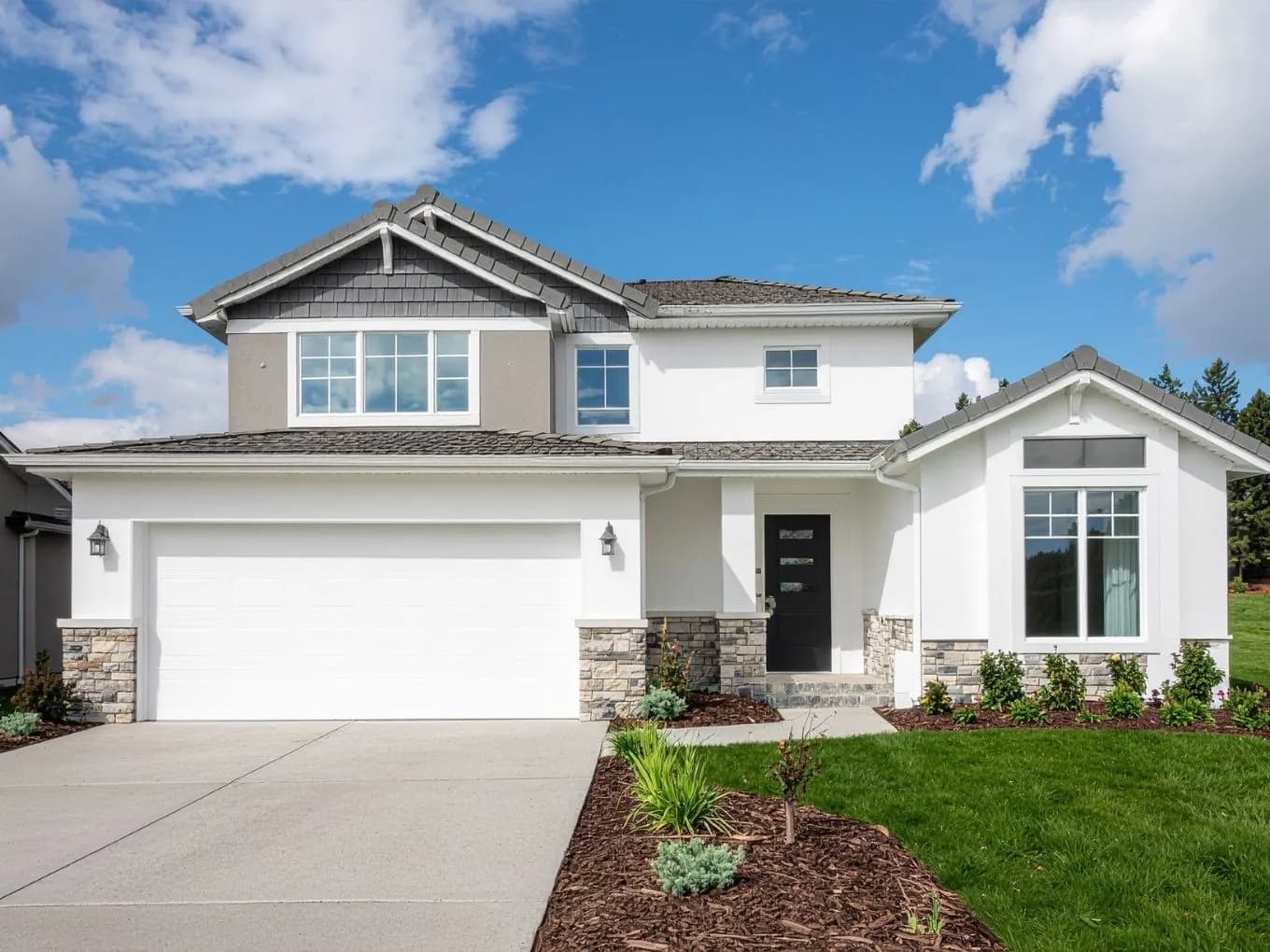
A Debt-Service Coverage Ratio (DSCR) loan is a mortgage that qualifies the borrower based on what their rental property earns, not what their paycheck or tax return says. DSCR stands for debt-service coverage ratio, and it compares monthly income from a rental property against the monthly debt payment of the same property. If the income covers the debt payments with room to spare, the loan works, regardless of your personal income.
That single shift, from borrower income to property income, is why DSCR loans have become the standard financing tool for real estate investors buying rentals. Below, we break down the meaning in plain terms, and walk through the numbers behind our DSCR Rental Loans program.
What Does DSCR Loan Mean, in Plain English?
DSCR loan calculation is simple: monthly income (rent)divided by monthly debt payment of the property. A normal mortgage looks at your W-2s, pay stubs, and tax returns. A DSCR loan looks only at whether the property's rent covers its own debt.
Here's how it plays out. Sarah wants to buy a rental property for $400,000. The home rents for $2,880 a month. Her full monthly payment, known as PITIA (principal, interest, taxes, insurance, and association dues), comes to $2,400: $1,900 in principal and interest, $300 in property taxes, $150 in insurance, and $50 in HOA dues. Divide $2,880 by $2,400 and you get a DSCR of 1.20, meaning the property brings in 20% more than its full monthly debt service every month. Dominion Financial requires a minimum DSCR of 1.20, so Sarah qualifies on the strength of the property alone.
No tax returns. No employment verification. No overcomplicated paperwork that makes deductions look unprofitable on paper.
Who Actually Uses a DSCR Loan?
Conventional underwriting works fine for a W-2 employee buying a primary residence. This isn't exactly the case for an active real estate investor. Four groups run into that gap most often.
Self-employed investors whose tax returns show write-offs and depreciation that understate real income, making it hard to qualify the conventional way even with strong cash flow.
Portfolio landlords who already own several properties, often recycling capital through strategies like the BRRRR method, and have hit the financed property limits most conventional lenders impose.
Out-of-state investors buying in markets they've researched for cash flow, where a fast, remote closing process matters more than a local relationship with a bank.
First-time rental buyers purchasing a single-family home or a small two-unit property who want a simpler file than a conventional loan requires.
Across all four groups, the common thread is the same. The deal should be judged on the property, not on paperwork that doesn't reflect how these investors actually make money. For the full breakdown of who qualifies and why, see our DSCR Loan Requirements guide.
Understanding Loan to Value (LTV) on a DSCR Loan
LTV, or loan to value, is the loan amount divided by the property's appraised value, and it sets how much cash you need to bring to closing. Dominion Financial caps DSCR loans at 80% LTV, meaning at least 20% down.
Say a borrower wants to buy a $500,000 rental with only 10% down, borrowing $450,000. That's a 90% LTV, and it does not meet our cap. To qualify, that same borrower needs to bring at least $100,000 to the table, keeping the loan at $400,000 or 80% LTV.
The logic behind the cap is simple. A lower LTV means more of the borrower's own equity is on the line, which gives Dominion Financial a bigger cushion if a deal ever goes sideways. It's also why LTV, alongside DSCR itself, is one of the first two numbers we check on any file.
Dominion Financial's DSCR Loan Program at a Glance
Here's how our DSCR Rental Loans program breaks down in full.
Feature | Dominion Financial DSCR Loan |
Qualification | Property rental income (no tax returns) |
Minimum DSCR | 1.20 |
Maximum LTV | 80% |
Rate structure | 30-year fixed, no call provision |
Minimum property value | $100,000 |
Eligible properties | Single-family and 2- to 10-unit residential |
Eligible entities | LLCs and individuals |
Minimum credit score | 680 |
Prepayment penalty | Declining points |
Typical closing time | As few as 10 days |
How the Loan Process Works
A DSCR loan moves in five steps once you're ready to apply.
Apply. You submit the property address, expected rent, purchase price, and your FICO score. No W-2s or tax returns.
AI-assisted underwriting. Our system checks comparable rents, estimates property value, reviews credit, and calculates DSCR in hours instead of days.
Program matching. Instead of forcing your deal into a single box, we run it against every major note buyer we work with to find the strongest fit.
Approval and pricing. You receive an approval with a rate, backed by our Price Beat Guarantee.
Closing. Documents get signed and funded in as few as 10 days, well under the 30- to 45-day timeline most traditional lenders need. This is the same fast track behind our Express Rental Loan program.
Why Investors Choose Dominion Financial
Two things separate Dominion Financial from most DSCR lenders: pricing leverage and closing speed.
Our Price Beat Guarantee exists because we're not limited to one loan program. We maintain relationships with every major DSCR note buyer, so when your deal comes in, we price it across that entire network and match or beat a competing offer rather than forcing your file into whatever single box a smaller lender has available.
Our AI-assisted underwriting drives the second advantage. Where traditional lenders take 30 to 45 days to close, our system evaluates comparable rents, property values, credit, and DSCR automatically, flagging only the exceptions that genuinely need a human decision. That gets qualified borrowers to closing in as few as 10 days.
In a market where real estate investors accounted for roughly 30% of all U.S. single-family home purchases in 2025, according to Cotality's Home Investor Report, closing speed is often the difference between winning a deal and watching a seller choose someone else. Sellers pick certainty and speed over a borrower who needs six weeks at the same price.
The Bottom Line
DSCR loan meaning comes down to a simple idea: your rental income qualifies the deal, not your tax returns. Dominion Financial backs that with an 80% LTV cap, a 30-year fixed rate, a 680 minimum credit score, and a Price Beat Guarantee built on relationships with multiple note buyers rather than one single program. For the deeper walkthrough of every requirement, see What Is a DSCR Loan? The Complete Guide.
Ready to see your numbers? Get your DSCR loan quote from Dominion Financial today.